Obedience Training
Teaching Recall That Works in Distracting Environments
Recall is the only cue I consider non-negotiable. A puppy who comes when called can be safely off leash on a hiking trail, recovered from a bolting moment at the front door, and trusted around livestock. But almost every owner I meet has the same problem: the recall works in the kitchen and falls apart in the park. The fix is not a louder cue or a better treat. It's a staged plan that respects how a puppy's attention actually develops.

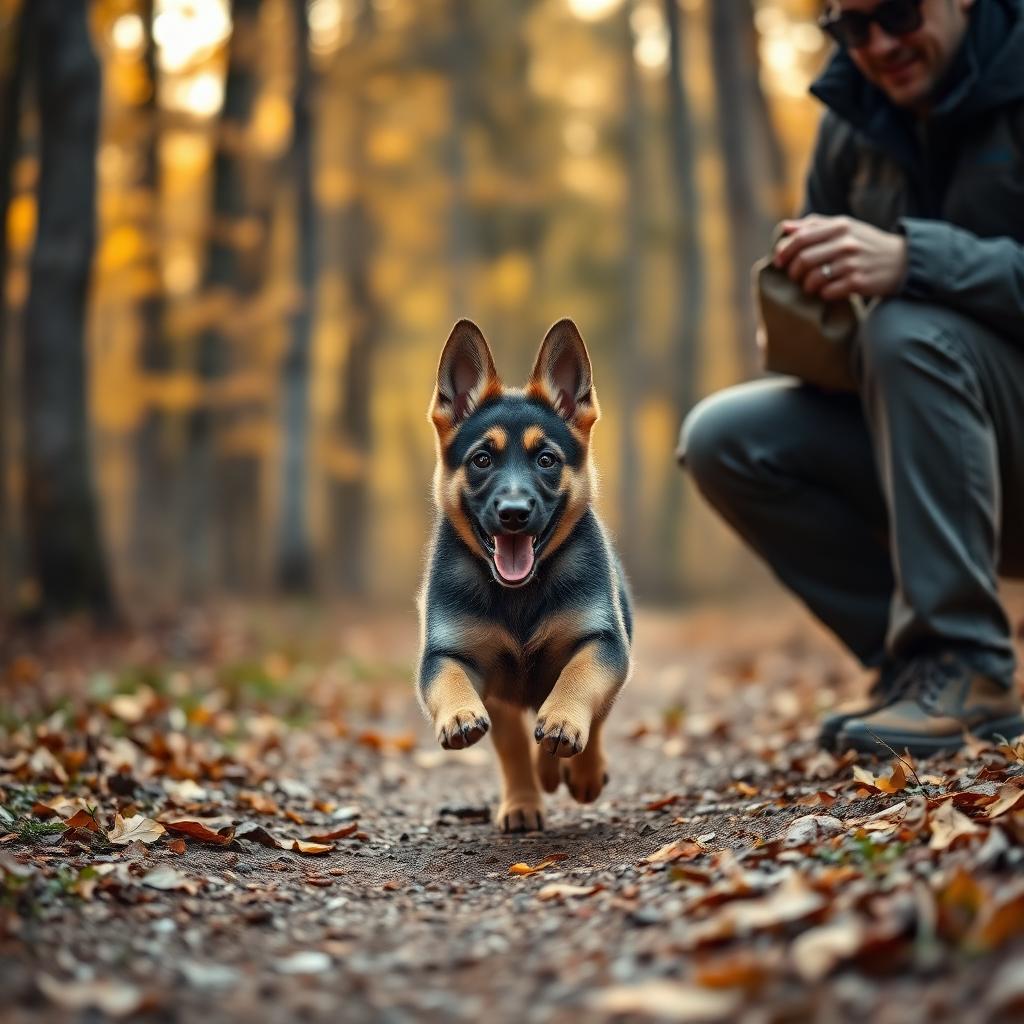
Why most recalls fail outdoors
When a puppy ignores 'come' at the park, owners usually assume the dog is being stubborn. They almost never are. What's happening is competing reinforcement: the smell of another dog, the crunch of leaves under a squirrel, the open sprint of a field — each of these is more rewarding than whatever you have in your pocket. Until your recall has been built with that competition in mind, it isn't trained. It's just rehearsed.
The other failure mode is poisoning the cue. If 'come' has ever predicted the end of fun (leash on, going home, bath), the puppy learns the word is a trap. The protocol below avoids that from day one.
Stage 1: Charge the word indoors (week 1)
Start in your living room with no other people or dogs. Say your puppy's name, then your recall word once — I prefer 'here' because owners rarely say it in casual conversation, unlike 'come'. The instant the puppy turns toward you, mark with 'yes' and deliver three small, high-value treats one at a time at your feet. Repeat 20 times across the day in tiny sets of three to five.
Use a food the puppy doesn't see at any other time. Freeze-dried liver, baked chicken, or a smear of plain Greek yogurt licked off a spoon all work. Boring kibble does not.
Stage 2: Add motion and distance (week 2)
Once the puppy snaps around on the cue indoors, start running away the moment you call. A puppy chases motion instinctively, which builds speed into the recall — a critical safety feature later. Keep distance short at first (10 to 15 feet) and progress to whole-house games where two people call back and forth from different rooms.
If your puppy doesn't sprint to you on a recall, the cue isn't ready for outdoors. Speed is the proof.
Stage 3: Mild distractions in the yard (week 3)
Move to a fenced yard with the puppy dragging a light 6-foot leash. Call them off easy distractions first — a stick, a low-grade smell. Pay even more generously than indoors. If the puppy ignores you, do not repeat the cue. Walk over, gently scoop the leash, and lead them silently back to where you called from. Reset and lower the difficulty.
Stage 4: Long-line work in low-stakes outdoor environments (weeks 4–8)
A 30-foot biothane long line is the single most important piece of recall equipment. It lets the puppy explore at a near-off-leash distance while you retain control. Choose a quiet park at off-hours. Let the puppy sniff for a full minute, then call. Pay big. Then release the puppy back to the smell with 'go sniff'. This is the magic step almost everyone skips: when coming back to you isn't the end of fun, your puppy will come back faster.
- Never let the long line go taut when you call. If the puppy doesn't respond, reel in gently — never yank.
- Aim for 20 successful recalls per session, paid every time. Drop to 10 if the environment is harder.
- Pair this work with our socialization checklist to make sure the puppy is comfortable in those environments in the first place.
Stage 5: Real-world proofing (months 3–6)
Only after dozens of successful long-line sessions across at least five different environments should you consider dropping the line. Even then, start in a fully fenced area. Build up to higher-stakes places: trailheads, beach paths, agility classes. Vary the reward — sometimes food, sometimes a tug toy, sometimes a release back to play.
Three rules you cannot break
- Never call your puppy to punish, scold, or do something they dislike (nail trim, bath). Go and get them instead.
- Never repeat the cue. One 'here' — then act if needed. Repeating teaches the puppy that the first call is optional.
- Always pay the recall, for the first year minimum. Even if the puppy is reliable. Reinforcement maintains behavior; without it, recall decays.
Recall is a relationship as much as a cue. You are competing with the entire outdoors for your puppy's attention — make coming back to you the best thing that happens all day, every day, and you'll have a dog who chooses you over the squirrel.
Key takeaways
- Recall fails outdoors because it was never trained against competing reinforcement.
- A 30-foot long line is the bridge between yard reliability and real off-leash work.
- Always pay, never punish on the cue, and never repeat the word.
Frequently asked questions
- What is the best age to start recall training?
- Day one at home, usually 8 weeks. Puppies that age have a natural orientation to their owner that fades around 16 weeks if you don't build on it. The earlier you start, the easier the long-line stage becomes.
- Should I ever use a shock collar for recall?
- I don't recommend it for puppies. Multiple studies, including work cited by the AVSAB, show aversive tools increase fear and aggression risk without improving long-term reliability beyond well-built positive protocols.
- How long until my puppy has a reliable off-leash recall?
- For most pet puppies, expect six to twelve months of staged training before truly reliable off-leash work in moderately distracting environments. High-drive breeds (huskies, hounds) may need longer or may always require a long line in open areas.
- What if my puppy comes 90 percent of the time? Can I drop the leash?
- No. A 90 percent recall in dog training is a failing grade — that 10 percent might be the squirrel near the road. Aim for 95 percent across at least 50 reps in a given environment before reducing management there.
Interactive tools
Use with this guide
Keep reading

Puppy Basics
The Puppy Training Schedule: A Calm, Repeatable Plan for Your First 30 Days
A trainer-built, day-by-day puppy training schedule for the first month. Routines, potty timing, naps, socialization, and what to skip.
14 min read
Obedience Training
Loose-Leash Walking for Puppies: How to Stop the Pulling Before It Starts
A force-free, mechanically simple way to teach a puppy to walk on a loose leash. Equipment, drills, and progression included.
9 min read
Obedience Training
How to Teach a Puppy the 'Place' Command (Settle on a Mat)
A step-by-step guide to teaching the 'place' command so your puppy settles calmly on a mat — even during dinner, doorbells, and Zoom calls.
10 min read
Obedience Training
How to Teach a Puppy Sit, Down, and Stay: The Complete Foundation Guide
A certified trainer's step-by-step protocol for teaching sit, down, and stay to a puppy — with luring, marker timing, duration ladders, and common mistakes.
14 min read
Obedience Training
Clicker Training vs. Verbal Marker: Which One Should You Use With Your Puppy?
A CPDT-KA trainer compares clicker training and verbal markers for puppies — timing, mechanics, pros and cons, and how to switch between them.
12 min read
Obedience Training
How to Stop a Puppy From Biting Hands: A Bite Inhibition Protocol That Actually Works
A certified trainer's evidence-based protocol for stopping puppy biting. Bite inhibition, redirection, arousal management, and what not to do.
13 min read
Continue learning
Explore the full The Ultimate Puppy Training Guide
A complete, trainer-reviewed roadmap to puppy training from week 8 through 12 months — foundations, obedience, leash manners, and adolescence.