Obedience Training
Clicker Training vs. Verbal Marker: Which One Should You Use With Your Puppy?
New puppy owners land in one of two camps within a week of starting training: the clicker camp, evangelized by a friend or a YouTube trainer, and the 'yes' camp, chosen because a clicker feels like one more thing to remember at 7 a.m. Both work. Both also fail in specific ways when misused. This guide is the framework I walk clients through in their first consult so they can pick a marker system deliberately rather than by accident — and switch if the one they picked stops serving them.

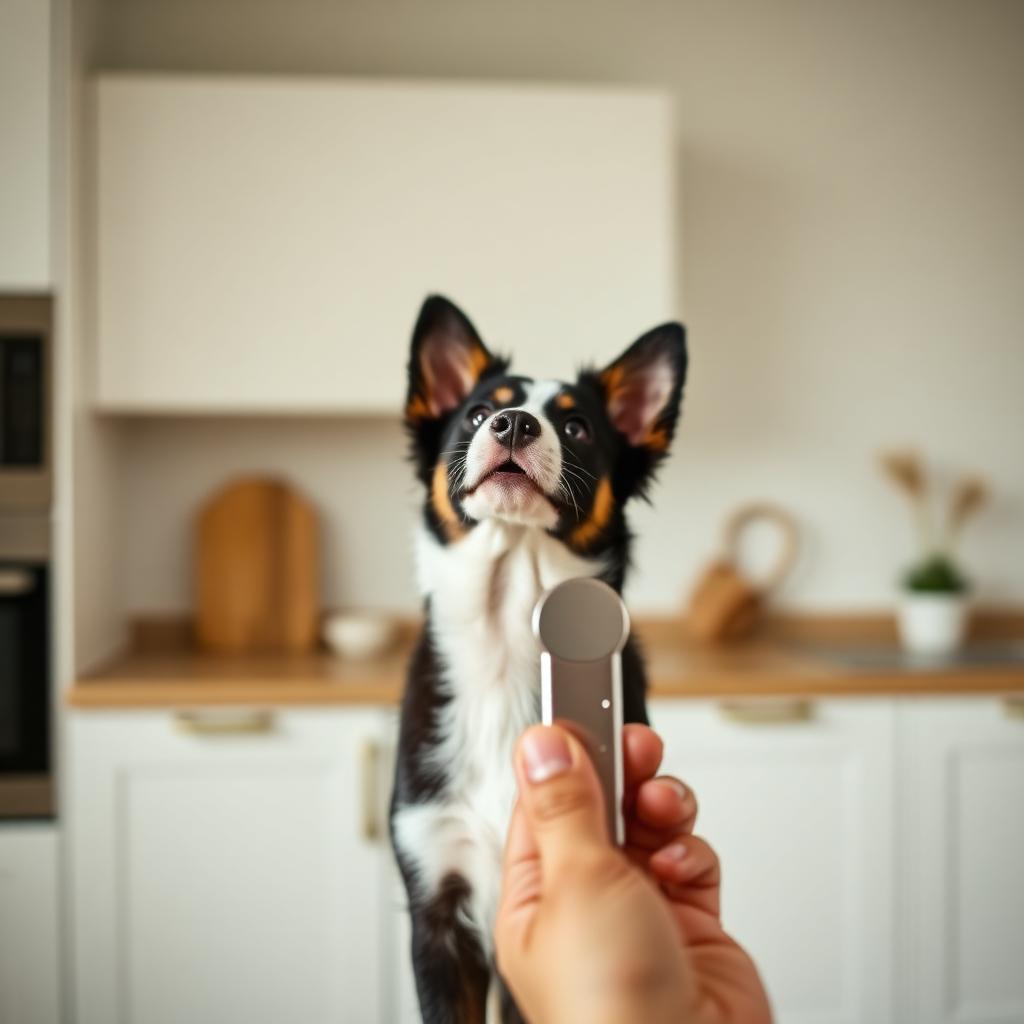
What a marker actually does
A marker is a bookmark. It tells your puppy 'that — the thing you were doing at this exact millisecond — is what I'm paying you for.' Without a marker, the reward arrives one or two seconds late, and your puppy has to guess what you liked. Two seconds is a lifetime in puppy learning. A well-timed marker collapses that guesswork and dramatically accelerates learning speed.
Marker signals fall into two useful buckets: a mechanical marker (a clicker) and a verbal marker (a short, crisp word your puppy hears nowhere else, usually 'yes'). Both have to be conditioned — the puppy has to learn that the sound predicts food. That conditioning takes about a hundred pairings, which most owners complete in the first two days.
The clicker: strengths and limits
A clicker is a small plastic box that produces an identical, sharp click every time you press it. Its greatest asset is consistency. Your voice varies with mood, coffee, and how many times the puppy peed on the rug that morning. The clicker doesn't. Research on marker signals consistently finds that mechanical markers speed up acquisition of new behaviors — especially micro-behaviors like paw lifts or head turns that require pinpoint timing.
The trade-off is logistical. You need a hand free to hold it, and if the clicker is in a drawer when your puppy does something magic on the sidewalk, you've missed the rep. Some sound-sensitive puppies also flinch at a standard clicker — for those dogs, a softer 'i-Click' or a ballpoint pen click works better.
The verbal marker: strengths and limits
A verbal marker is a short, distinct word (usually 'yes,' sometimes 'good,' 'yep,' or 'ping') delivered in the same crisp tone every time. Its greatest asset is availability — your mouth is always with you. For real-world urban training, walks in the park, or catching a spontaneous polite greeting at the front door, verbal markers win on pure logistics.
The catch is consistency. If 'yes' sometimes means treat, sometimes means 'yes, honey, in a minute,' and sometimes gets bumped into casual conversation, the marker loses meaning. Trainers who use verbal markers exclusively usually pick a word they truly don't say in daily life — 'zip,' 'ping,' or 'click' spoken aloud — to protect its salience.
Side-by-side comparison
- Timing precision — Clicker: excellent. Verbal: good, if practiced.
- Consistency — Clicker: near-perfect. Verbal: depends on the human.
- Availability — Clicker: only when in hand. Verbal: always.
- Learning speed for new behaviors — Clicker slightly faster in research studies.
- Learning speed for known cues — Effectively identical.
- Sound sensitivity — Clicker can startle. Verbal is gentler.
- Ease of use for children in the household — Verbal is simpler.
For most family households, I recommend starting with a verbal marker for daily life and adding a clicker for deliberate skill-building sessions (heel work, place command, tricks). This hybrid gives you precision when you need it and portability the rest of the time.
How to charge either marker
Charging (or 'loading') a marker means pairing the sound with food until the sound alone predicts a treat. The protocol is identical for both:
- Sit on the floor with 20 pea-sized treats and a calm puppy.
- Click (or say 'yes') — pause half a second — deliver a treat.
- Vary the interval slightly: sometimes 1 second, sometimes 3 seconds, so the puppy doesn't just tune the sound out.
- Repeat 20 times per session, 3 sessions across the first day.
- On day two, test: click or say 'yes' when the puppy is looking away. If they whip their head to you expecting food, the marker is charged.
Switching between systems (or using both)
You are allowed to change your mind. If you started with a clicker and it lives permanently on the kitchen counter, switch. If you started with 'yes' and want a clicker for polishing heelwork, add one. To transition, charge the new marker for two days while continuing to use the old one, then use both interchangeably for a week, then let the old one fade.
Advanced trainers often use both simultaneously. In my puppy classes, I use a clicker in structured drills and a verbal marker for anything the puppy offers spontaneously between drills. The two signals coexist without confusion because both are consistently paired with food.
Mistakes that make markers meaningless
- Marking without paying. Every mark must be followed by food — this is the contract.
- Marking late. If the puppy has already stood up and looked away, the mark labels the wrong behavior.
- Using the marker to get the puppy's attention rather than to label a behavior they just performed.
- Praising over the marker ('yes, good boy, YES!'). Say the marker once and then pay.
- Fading the marker too early. Puppies still benefit from marker-plus-treat pairing well into adolescence.
Marker training is the invisible skeleton behind every well-timed cue and every calm 'leave it.' Pick a system, charge it well, and defend its integrity — the payoff is a puppy who learns roughly twice as fast as one being trained without a marker at all.
Key takeaways
- Markers are bookmarks — they label the exact behavior that earns the reward.
- Clickers win on precision; verbal markers win on availability.
- A hybrid — verbal marker for daily life, clicker for skill sessions — suits most households.
- Every mark must be followed by food. That contract is what gives the marker meaning.
- Change systems whenever the current one stops fitting your life; both will work if used consistently.
Frequently asked questions
- Which is better for beginners — a clicker or a verbal marker?
- A verbal marker ('yes') is easier for beginners because there's no extra object to juggle. Add a clicker later if you want more precision for skill work.
- How long does it take to charge a clicker or verbal marker?
- About 60 pairings, which most owners finish across three short sessions in one day. On day two, most puppies orient to the sound before the food arrives.
- Can I stop using the marker eventually?
- Yes, once a behavior is fluent and generalized. Fade the marker gradually — reward every third correct rep, then every fifth — while keeping praise. Bring the marker back whenever you're teaching a new behavior.
- My puppy is scared of the clicker. What should I do?
- Muffle the click in your pocket for a week, or switch to a softer 'i-Click,' a ballpoint pen click, or a verbal marker. Some sound-sensitive puppies never take to a standard clicker, and that's fine.
Interactive tools
Use with this guide
Keep reading

Obedience Training
Loose-Leash Walking for Puppies: How to Stop the Pulling Before It Starts
A force-free, mechanically simple way to teach a puppy to walk on a loose leash. Equipment, drills, and progression included.
9 min read

Obedience Training
How to Teach a Puppy Sit, Down, and Stay: The Complete Foundation Guide
A certified trainer's step-by-step protocol for teaching sit, down, and stay to a puppy — with luring, marker timing, duration ladders, and common mistakes.
14 min read
Obedience Training
How to Stop a Puppy From Biting Hands: A Bite Inhibition Protocol That Actually Works
A certified trainer's evidence-based protocol for stopping puppy biting. Bite inhibition, redirection, arousal management, and what not to do.
13 min read

Obedience Training
Puppy Impulse Control Games: 8 Trainer-Approved Exercises for a Thinking Dog
Eight impulse-control games a certified trainer uses to teach puppies to pause, think, and choose calm — from Doggy Zen to the Premack pattern.
12 min read
Obedience Training
How to Teach a Puppy 'Leave It' and 'Drop It': A Two-Cue Safety Protocol
A CPDT-KA trainer's step-by-step protocol for teaching leave it and drop it — the two cues that keep a puppy safe from sidewalk hazards and chewed shoes.
12 min read

Obedience Training
The Puppy Training Timeline: What to Teach at Every Age From 8 Weeks to 12 Months
A month-by-month puppy training timeline from a certified trainer — exactly which skills to prioritize at each developmental stage, and what to skip.
15 min read
Continue learning
Explore the full The Ultimate Puppy Training Guide
A complete, trainer-reviewed roadmap to puppy training from week 8 through 12 months — foundations, obedience, leash manners, and adolescence.