Nutrition & Feeding
Raw vs. Kibble vs. Fresh Puppy Food: A Vet-Reviewed Comparison
The moment you get home from the breeder, someone will tell you kibble is poison, someone else will tell you raw is dangerous, and a third person will insist the boutique fresh subscription in the mail is the only ethical choice. All three can point to a study. Very few can point to a puppy. After a decade of watching families cycle through diets, the pattern is boringly consistent: the best puppy food is the one that meets a real nutritional standard, matches your puppy's growth trajectory, and that you can actually keep buying twelve months from now. This article strips the marketing off each category and lines them up against the evidence.

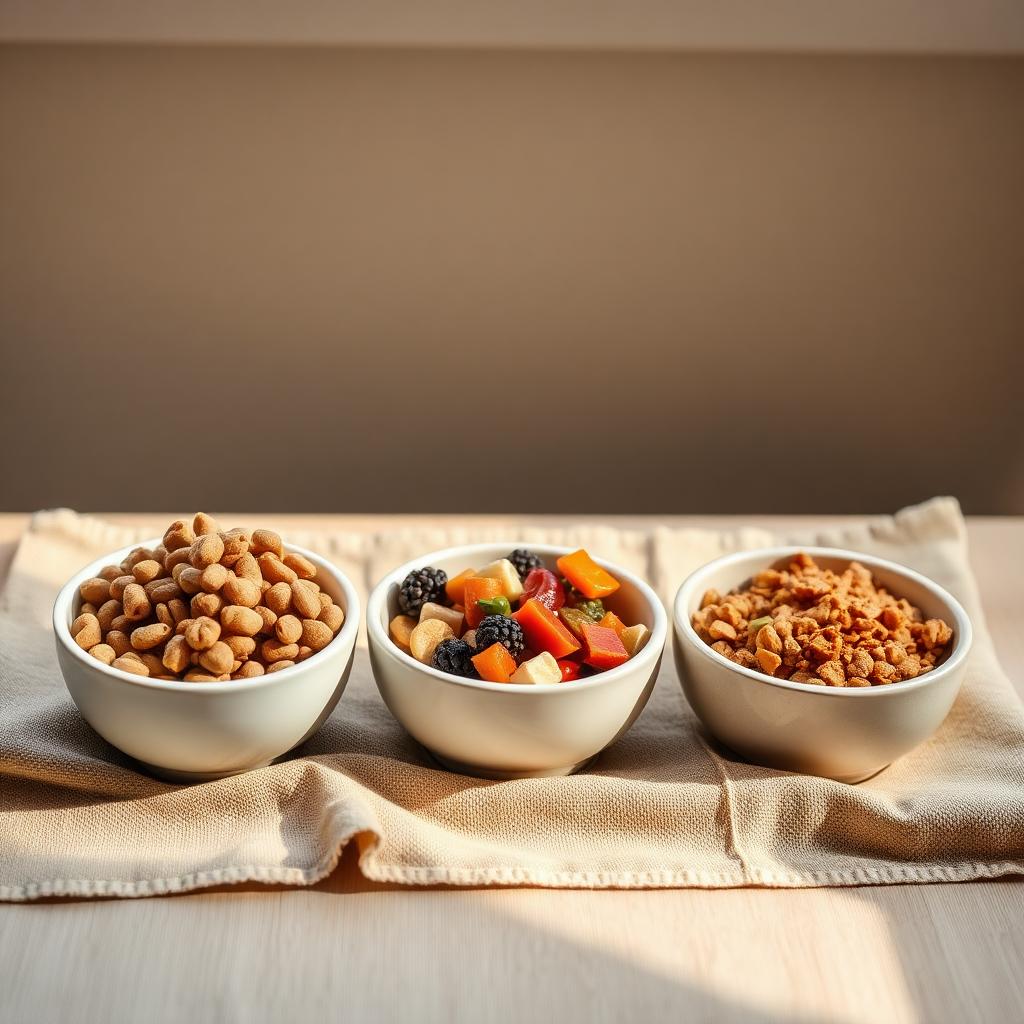
How we compare diet types
There is no such thing as a 'best food' in the abstract. The only meaningful comparison is against four measurable criteria: does the diet meet the AAFCO growth standard, is the calcium-to-phosphorus ratio appropriate for the puppy's projected adult size, is manufacturing quality controlled, and does the puppy actually digest it. Everything else — sourcing story, brand aesthetics, breeder recommendation — is downstream of those four. When you evaluate raw, kibble, and fresh through that lens, the differences become concrete instead of ideological.
One more baseline before we dig in: puppies have a much narrower nutritional tolerance than adult dogs. A 10% error in calcium is a rounding issue in a five-year-old Labrador. In an eight-week-old Labrador, sustained over three months, it changes bone remodeling. This is why the AAFCO growth statement — a feeding-trial or nutrient-profile substantiation specific to growth — matters more than any single ingredient.
Kibble: the default that keeps winning trials
Extruded dry food gets more criticism than any other category, mostly for aesthetic reasons — it doesn't look like food. But when you filter the market by 'AAFCO feeding-trial substantiated for growth,' kibble is where most of the survivors sit. Big-brand puppy formulas are the most nutritionally consistent product in the pet-food aisle, largely because they can afford both feeding trials and third-party analytical verification of every batch.
What kibble does well
- Consistent calorie density and moisture — portioning is straightforward.
- Long shelf life; a bag opened correctly stays stable 4–6 weeks.
- Wide price range with credible options under $3/lb for medium-breed puppies.
- Large-breed puppy formulas are calcium-controlled — critical for puppies whose adult weight exceeds 50 lb / 23 kg.
- Feeding-trial data on many major brands (not the same as 'formulated to meet').
Where kibble falls short
Palatability is the biggest real-world weakness, especially in tiny toy breeds or picky small terriers. Kibble is also the most heavily processed of the three categories, which matters more emotionally than nutritionally — the amino acid profile after extrusion is well within growth requirements when the formula is right, but critics are correct that some heat-sensitive nutrients are added back in premix form rather than surviving cooking. Choose a formula whose ingredient list starts with a named animal protein and whose AAFCO statement explicitly mentions growth.
Gently cooked fresh: the middle path
Fresh subscription brands — the kind that arrive in a cooler with a printed puppy name on the package — are the fastest-growing category in premium pet food and, for well-designed formulas, a defensible choice for puppies. The best of them run AAFCO feeding trials on their growth formulas. The worst are re-heated online marketing with a supplement dumped in.
How to vet a fresh-food brand
- Look for an explicit AAFCO growth statement on the packaging — not on adult formulas.
- Check that the brand employs a full-time, board-certified veterinary nutritionist (DACVN). Many do not.
- Confirm the calcium-to-phosphorus ratio is 1.1–1.4:1 for standard puppies, and tightly controlled for large breeds.
- Verify the cooking process and the storage/thawing instructions match your fridge and lifestyle.
- Price out three months at your puppy's projected adult weight — sticker shock at month two is a nutrition risk when owners cut portions.
Raw diets: where the risk sits
The AVMA, the FDA, and the American Animal Hospital Association all discourage raw meat–based diets for puppies. Their reasoning is not ideological; it is pathogen load. Puppies shed more Salmonella and Campylobacter than adult dogs when fed raw, and immunocompromised humans in the household — infants, elderly relatives, anyone on chemotherapy — are exposed to those pathogens on floors, bowls, and the puppy's coat after grooming. The nutrient-balance issue is the second problem: home-formulated raw is nutritionally deficient in something like 60% of published analyses, most often calcium, vitamin D, zinc, or copper.
That does not mean every owner feeding raw is wrong. It means the burden of evidence is higher: use a commercial raw diet that has passed AAFCO feeding trials for growth, freeze at –18 °C or lower for the recommended pathogen-reduction window, and handle it with the same hygiene rules you would use for raw chicken destined for human dinner. If you cannot commit to all three, this category is not the right pick for a puppy.
Cost, storage, and the twelve-month test
The single biggest predictor of a diet change during puppyhood is cost drift. Owners choose a $200/month plan for an eight-week-old ten-pound puppy, then quietly downgrade at month four when the puppy is thirty pounds and eating more. Diet switches during the growth window aren't harmful in isolation, but repeated switches often mask the digestive intolerance that would have shown up as a signal on a stable diet. Run the numbers for month twelve at projected adult weight before you commit — our feeding guide by age gives you the multiplier.
The best diet is the boring one you'll still be feeding at month twelve. Consistency, not cuisine, is what grows a healthy adult dog.
How to actually choose
For most families, a feeding-trial kibble in the correct life-stage and size formula is the right starting point — not because it's fancy, but because it is the most likely to hit every nutrient window with the least effort. Owners with the budget and the fridge space for a properly formulated fresh diet get a modest palatability and satiety edge with no clear developmental advantage. Raw is the highest-risk category and, for puppies, should only be chosen with a commercial formula, careful handling, and (ideally) veterinary sign-off. Whichever category you land on, cross-check it against our full framework in the best food for puppies guide, then plan the transition using our step-by-step food-transition protocol so the switch doesn't cause a week of soft stool.
Key takeaways
- AAFCO growth substantiation — ideally by feeding trial — is the single most important label to check.
- Kibble is the most consistent nutritional platform for most puppies; fresh is a defensible upgrade if the brand is rigorously formulated.
- Raw is the highest-risk category for puppies; if you choose it, use a commercial AAFCO-tested formula and strict handling.
- Large-breed puppies need calcium-controlled formulas regardless of diet category.
- Consistency across the growth window matters more than category. Plan for month twelve before you buy month one.
Frequently asked questions
- Is homemade food ever a good idea for puppies?
- Only when the recipe is formulated by a board-certified veterinary nutritionist (DACVN) for your specific puppy's size and life stage. Generic online recipes are nutritionally incomplete in the majority of published analyses.
- Can I mix kibble and fresh food?
- Yes — that is one of the most common real-world combinations. Feed each as a percentage of daily calories rather than a full portion of each, and only mix diets that individually meet the AAFCO growth standard.
- Does raw food make a shinier coat?
- Fat content and omega-3 profile drive coat quality, not the cooking method. A high-quality kibble with named animal protein and added DHA produces the same coat outcome without the pathogen risk.
- Is grain-free better?
- No. The FDA's ongoing investigation into diet-associated dilated cardiomyopathy has centered on certain grain-free formulas. Unless prescribed for a diagnosed grain sensitivity, choose a puppy formula with named whole grains.
Keep reading

Nutrition & Feeding
How to Choose the Best Food for Your Puppy: A Trainer & Vet-Reviewed Framework
A practical framework for choosing puppy food — AAFCO statements, large vs. small breed, ingredients, and feeding amounts.
10 min read

Puppy Health
Puppy Diarrhea: Causes, Home Care, and When to Call the Vet
A clear, vet-reviewed guide to puppy diarrhea — common causes, safe home care, and the specific red flags that mean call the clinic now.
11 min read
Nutrition & Feeding
How to Transition Puppy Food Safely: A Trainer + Vet Protocol
The 10-day food transition schedule vets use for puppies, plus what to do when you're switching brands, life stages, or coming home from the breeder.
12 min read

Nutrition & Feeding
Puppy Hydration: How Much Water, When, and Signs of Dehydration
A vet-reviewed puppy hydration guide — daily water needs by weight, dehydration signs, water for training, and when overnight water should be pulled.
11 min read

Nutrition & Feeding
The Puppy Training Treats Guide: Calories, Value, and What to Use When
A trainer's guide to choosing, sizing, and rotating puppy training treats — calorie limits, value hierarchies, homemade options, and what to avoid.
12 min read

Nutrition & Feeding
Puppy Food Allergies vs. Intolerances: How to Tell the Difference
How to tell if your puppy has a true food allergy or a food intolerance — signs, elimination diet protocol, and when to see a veterinary dermatologist.
13 min read
Continue learning
Explore the full The Complete Puppy Nutrition Guide
Vet-reviewed guide to feeding puppies from 8 weeks to adulthood: choosing food, portion sizes by breed, treats, and transitioning to adult food.