House Training
Nighttime Puppy Potty Training Without the Crying
There is a specific kind of exhaustion that comes with a puppy's third night home. You've been up twice, you can't tell if the whining is potty or panic, and the internet has given you ten contradictory rules. This guide is the protocol I walk new owners through every week. It's built around two assumptions: your puppy genuinely needs to potty more often than an adult dog, and your puppy can also learn to sleep — usually within ten to fourteen nights — if the setup is right.


What a puppy bladder can actually hold
The widely cited rule is 'one hour per month of age, plus one'. That works for daytime, when the puppy is moving, drinking, and processing food. At night, with no fluid intake and lower activity, most healthy puppies can hold longer — usually four to six hours by 8 weeks, six to eight by 12 weeks, and overnight by 14 to 16 weeks. The variance is enormous: tiny breeds and recently weaned puppies need more frequent breaks. Build the schedule around your specific puppy, not a chart.
Bedroom and crate setup that prevents 80 percent of crying
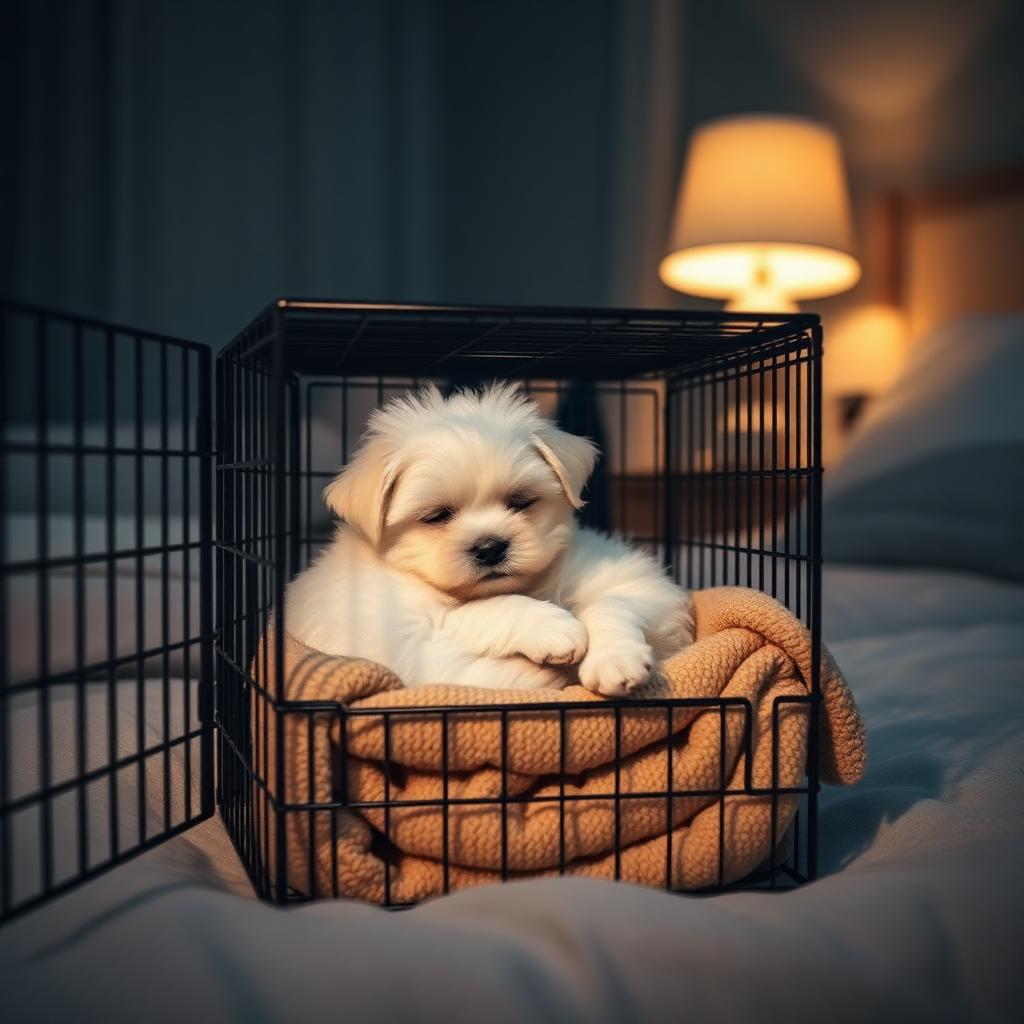
Almost every 'my puppy cries all night' case I take ends within three nights of moving the crate. Puppies are pack sleepers. Asking an 8-week-old to sleep alone in a laundry room on night one is, behaviorally, asking a human infant to sleep on the porch. The crate should be next to your bed, close enough that you can drop a hand inside it.
- Size the crate for the puppy plus 6 inches — too large invites in-crate accidents.
- Use a soft, washable blanket and one safe chew (a frozen Kong helps the first three nights).
- Cover three sides with a breathable blanket to create a den feel.
- Place a worn t-shirt of yours inside; scent reduces cortisol within minutes.
- Keep a leash and shoes by the bed so the wake-up is fast and silent.
If you haven't yet introduced the crate as a positive space, pause here and run the desensitization sequence in our crate training without crying guide before starting overnight work.
An hour-by-hour overnight plan (8–12 week puppy)
- Last meal: 5.5–6 hours before bed. No food after that.
- Last water: 2 hours before bed. Remove the bowl.
- Pre-bed routine, 30 minutes out: calm chew time, dim lights, no roughhousing.
- Final potty trip 10 minutes before bed. Wait it out — no playing, no praise yet, just stand and let it happen.
- Reward the potty with one quiet treat, then straight into the crate.
- Set an alarm for 4 hours after lights-out (3 a.m. if you're a midnight sleeper, 2 a.m. if earlier).
- Take the puppy out before they wake themselves. Pre-empting cry-driven wake-ups is the difference between a learning puppy and a panic puppy.
Handling the 3 a.m. wake-up
Keep the lights low and your voice flat. Pick the puppy up — do not let them walk to the door, because the movement triggers the bladder and you'll get an accident in the hallway. Outside, stand still in the chosen potty spot. No conversation, no play. The instant they go, one calm 'yes' and one treat, then directly back to the crate.
If they refuse to potty within five minutes, return to the crate anyway. Sometimes the wake-up was a false alarm. Do not let the puppy out of the crate to 'try again' or you'll teach a manipulative cry.
Weaning off middle-of-night breaks
Once the puppy is reliably dry on the 3 a.m. trip for five consecutive nights, push the alarm 30 minutes later. Hold that new time for five nights. Continue stretching in 30-minute increments. Most puppies are sleeping a full 6 to 7 hours by 12 weeks and a full night by 14 to 16 weeks. If you regress (sudden accidents after a dry stretch), don't punish — back the schedule up one step for a week.
Three mistakes that prolong the misery
- Crate in another room from day one. The puppy is panicking, not testing you. Move it next to you for the first two weeks.
- Letting the puppy out of the crate when they cry. You teach the cry. Take them out for potty only, no play, no cuddles.
- Punishing in-crate accidents. The puppy isn't being defiant; the schedule is too long. Shorten the gap, clean with an enzymatic cleaner, and reset.
Nighttime training is finite. Two weeks of disciplined setup buys you a dog who sleeps in their own bed for the next twelve years. Combine this with the daytime routine from our 30-day puppy training schedule and you'll see consolidated sleep faster than almost any other intervention.
Key takeaways
- Put the crate next to your bed for the first two weeks — proximity prevents most crying.
- Pre-empt overnight accidents with a scheduled wake-up, then stretch it 30 minutes at a time.
- Keep the wake-up boring: no lights, no chat, potty only, back to bed.
Frequently asked questions
- Should I let my puppy sleep in my bed?
- Not in the first 8 to 12 weeks. The crate teaches independent sleep, prevents falls, and gives you reliable overnight potty management. You can always move them to the bed as an adult; you can't easily un-train co-sleeping later.
- My puppy cries the moment I close the crate. What do I do?
- Stop and rebuild crate love during the day with food, chews, and short closed-door sessions. Don't make nighttime the first time the door closes. Our crate training guide walks through the full desensitization.
- Is it normal for an 8-week-old puppy to wake up twice at night?
- Yes. Most need one to two overnight potty trips for the first three to five weeks at home. By 12 weeks the majority are down to one trip; by 14 to 16 weeks, most sleep through.
- What if my puppy has accidents in the crate?
- Three causes, in order of likelihood: the crate is too big, the gap between potty breaks is too long, or there's a urinary tract issue. Adjust the first two; if accidents persist after a week of tightening the schedule, see your vet.
Interactive tools
Use with this guide
Keep reading

Puppy Basics
The Puppy Training Schedule: A Calm, Repeatable Plan for Your First 30 Days
A trainer-built, day-by-day puppy training schedule for the first month. Routines, potty timing, naps, socialization, and what to skip.
14 min read
House Training
Crate Training a Puppy Without the Crying: A Step-by-Step, Welfare-First Method
A trainer's gentle, evidence-based protocol for crate training a puppy without distress vocalization. Day-by-day plan included.
11 min read

Puppy Health
The Puppy Vaccination Schedule, Explained: What, When, and Why
A plain-English guide to the core puppy vaccine schedule from 6 to 16 weeks, plus optional vaccines and what to expect at the vet.
8 min read
House Training
How to Stop Puppy Submissive and Excitement Urination (Without Making It Worse)
Why puppies pee when greeting people, and the calm, evidence-based steps to fix submissive and excitement urination without damaging confidence.
10 min read

Socialization
The Puppy Socialization Checklist: 14 Categories of Positive Experiences (3–14 Weeks)
A trainer-built socialization checklist for the critical 3–14 week window. People, dogs, surfaces, sounds, and handling — done safely.
12 min read
Obedience Training
Loose-Leash Walking for Puppies: How to Stop the Pulling Before It Starts
A force-free, mechanically simple way to teach a puppy to walk on a loose leash. Equipment, drills, and progression included.
9 min read
Continue learning
Explore the full The House Training Hub
A complete, trainer-reviewed system for house training a puppy: crate work, potty schedules, overnight routines, and troubleshooting.